Friday, November 4, 2022

L.L. Holt in 2022 virtual interview on music, critics, bloopers, and fun

 https://virtualvenue.feelitlive.com/fa8bac77-5d4b-445c-bcbc-d44f094bbc50

Here is a link to this lively, laugh-filled interview program conducted weekly on the Internet by Win Derman. Alternatively, search for FeelItLive, the Win-Win Show, Episode 55 with Dr. Linda Holt . Click on the link above, not the photo below.


Friday, December 18, 2020

Review of 3-minute 40-second Ode to Joy performance by Igor Levit

12/15/20 Eve of Beethoven's 250th Birthday

This was also published in ConcertoNet.com

Igor Levit, the young German-Russian pianist, knows how to get to the heart of a matter.

In 2016, he delayed a performance to address the audience on tolerance and human rights. This May he live-streamed Erik Satie’s Vexations for a global audience, repeating the same four lines for nearly 20 hours to express the frustration of artists during the pandemic. Without fanfare, he has recorded the complete 32 Beethoven piano sonatas for release during the composer’s 250th birthday year.

Now, on the eve of that birthday, I have the pleasure of reviewing something much shorter, but perhaps even more to the point: Levit’s performance of the Ode to Joy from the Ninth Symphony, as transcribed by Franz Liszt. This transcription is less than four minutes in length but acts as a punctuation mark for all we have suffered, endured, and perhaps triumphed over in the memorable year of 2020.

The transcription begins at the point where the cellos and basses softly announce the familiar theme. It ends with some Lisztian flourishes and sinks back into the simplicity of the opening well before the first words ever heard in a symphony: “O Freunde, nicht diese Tรถne.” (“Friends, let’s not have these somber tones.”)

Of course, there are no cellos, basses, and baritones in this recording. There is only Igor Levit. And Beethoven.

The theme begins meekly, in naked simplicity. It is a handful of seeds—plain, homely, covered with soil—sown by a farmer with a great vision. The farmer knows it will take much work, much cultivation to bring these small unprepossessing pieces to fruition. They look like little bits of stone, with no value. But with care and nurturing, they take root and sprout. Fast forward to a time when all the previously untilled land—everything we think of as dirt, mud, and filth—is covered with glistening greenery, and the seed has turned into a cornfield, a forest, a living world.

Beethoven’s music is nothing if not organic. Like seeds with careful tending, the tendrils of his music spread and insinuate themselves into our souls. A man of the cloth as well as a composer and musician, Liszt knew what he was doing when he took Beethoven’s own development of this theme early in the Ninth pretty much as is, then let it grow naturally into an inevitable conclusion. Liszt hands it off to the performer, and it is up to Levit to interpret the shape and flow of this little piece over the course of three minutes and forty seconds. This he does with customary brilliance, turning a short-lived miniature into a harkening of eternity.

And so together, we may say, Happy Birthday, Herr Beethoven. And thank you.

                                                                                                                                              --Linda Holt


Saturday, September 19, 2020

Rabinovich and SCO: delightful classics at Lammermuir

by Linda Holt

Life is seeping back into the worldwide classical music community, and, to quote Fred Rogers, it’s a “lovely day in your neighborhood” when musicians of the caliber of Roman Rabinovich and the Scottish Chamber Orchestra are playing Mozart and Beethoven live for all to stream.

I caught the Israeli pianist and a quintet of SCO musicians on the last night of the Lammermuir Festival’s concert series September 19 (a Janacek opera was scheduled to follow on the 20th). Like practically all musical events in spring, summer, and autumn of 2020, the Lammermuir Festival was rattled by the consequences of the pandemic, but emerged unbowed in September rather than April or May, and with a schedule of performances different, but in no way diminished, from original expectations.

Performed in the 250-year-old Holy Trinity Church in Haddington, East Lothian, Scotland, Saturday evening’s concert featured a socially distanced subset of the SCO playing Mozart’s plaintive String Quintet No. 5 in G minor K. 516, followed by a real treat: a chamber rendition of Beethoven’s Third Piano Concerto in C minor, Op. 37 arranged for string quintet and piano by Vincenz Lachner.

The acoustics of Holy Trinity are quite good, embracing the mellow, woodsy voices of two violins (Ruth Crouch and Gordon Bragg), two violas (Felix Tanner and Brian Schiele), and cello (Donald Gillan). The mood of their playing was soft and reflective in a work which often lends itself to emotionalism which some reviewers think is outside the scope of the classical tradition. Both approaches have their merits, and while my ears were perfectly content to resonate with the ensemble’s tender murmurings, a little more of that G minor Angst wouldn’t have hurt, especially in the third movement. But for pure loveliness and exquisite musical sensibility overall, you could not do better than this interpretation.

Roman Rabinovich pumped up the volume the instant his fingers first fell upon the keys, and oddly enough, it sounded fabulous with a mere five musicians (the second viola swapped out for a double bass played by Nikita Naumov) as his musical partners, as opposed to the full orchestra we most often hear.


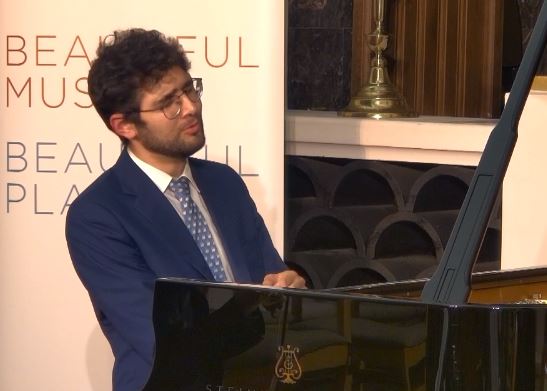
Roman Rabinovich at Lammermuir

Rabinovich is an exciting musician to watch and listen to, and I don’t mean exciting in the sense of histrionics. While his facial expressions and gestures do reflect the moods of the music, there is nothing artificial about this performance. His playing—at once assertive and seductive—reveals the true, full-blooded Beethoven: the emerging Romantic, the technical wizard, the bearer of the Promethean flame. Rabinovich knows that Beethoven wields trills—the Milquetoast ornaments of an earlier age—as though they were light sabers, ready to slash through hypocrisy and liberate music from all restriction.

I was amazed at just how fine the SCO instrumentalists sounded in sync with this powerful but insightful unfolding of a familiar masterwork. With its passionate minor mood radically shifting to C major at the end, the concerto seems to foretell a return to life, perhaps even a resurrection. It’s an apt term for what musicians around the world are experiencing as they return to the stage, and not a bad metaphor to use in a church.

My review of another Lammermuir Festival concert appears in Bachtrack here:  https://bachtrack.com/review-video-purcell-dunedin-consort-lammermuir-festival-september-2020