Review of Opera Philadelphia's inclusive Madame Butterfly, April 28, 2024, published in Broad Street Review:
https://www.broadstreetreview.com/reviews/opera-philadelphia-presents-puccinis-madame-butterfly

Photo by Sofia Negron
Review of Opera Philadelphia's inclusive Madame Butterfly, April 28, 2024, published in Broad Street Review:
https://www.broadstreetreview.com/reviews/opera-philadelphia-presents-puccinis-madame-butterfly
Philadelphia-born singer Marian Anderson is being honored as she deserved with the rededication of Verizon Hall in her name in June 2024. The announcement was made in the hall's home in the Kimmel Center for the Performing Arts in Philadelphia on February 28, 2024, during a ceremony attended and featuring remarks by leading officials and performing artists, including Lt. Gov. Austin Davis, Mayor Cherelle Parker, and soprano Denyce Graves. The Kimmel Center is the home of the Philadelphia Orchestra, Yannick Nézet-Séguin, music director.
Below is further information from the Center's press release on the rededication and its implications for the City of Philadelphia, the sixth largest city by population in the United States. "Art and culture are part of what makes a city great," said Mayor Parker, the first African-American woman to serve in her leadership role. In an emotional speech, Nézet-Séguin praised the musicians of the Philadelphia Orchestra for their dedication to justice and inclusivity as well as to music. "No orchestra has a bigger heart," he said.
.jpg)

Yannick Nézet-Séguin, Music and Artistic Director, joins President and CEO Matías Tarnopolsky (left) during the rededication announcement honoring the great contralto, Marian Anderson. That’s one of Marian Anderson’s gowns on the right. Copyright and photo by Margo Reed.
From the Press Release: Philadelphia Orchestra President and CEO Matías Tarnopolsk y and Music and Artistic Director Yannick Nézet-Séguin announced today that Verizon Hall at the Kimmel Center for the Performing Arts will be rededicated as Marian Anderson Hall in honor of the legendary contralto, civil rights icon, and Philadelphian. Announced the day after what would have been Anderson’s 127th birthday, the news marks the first major concert venue in the world to honor the late performer and trailblazer.
Located in the heart of her hometown of Philadelphia, Marian Anderson Hall at the Kimmel Center for the Performing Arts will be a permanent monument to its namesake’s artistry and achievements, a reflection of the inclusive future she helped to engender, and an active testament to the intersection of music, art, and positive social impact.
The Hall—home of The Philadelphia Orchestra—will officially be rededicated on June 8, 2024, and celebrated during the Great Stages Gala and concert that evening, featuring Nézet-Séguin and The Philadelphia Orchestra with actress and singer Audra McDonald, soprano Angel Blue, jazz pianist Marcus Roberts, and more to be announced at a later date.
Reprinted from ConcertoNet.com - Review by Linda Holt of Bruckner's Ninth with Te Deum as the final movement:
Philadelphia
Verizon Hall
05/05/2023 - & May 6, 2023
Anton Bruckner: Christus factus est – Symphony No. 9 in D minor – Te Deum (Nowak Edition)
Elza van den Heever (soprano), Michelle DeYoung (mezzo-soprano), Sean Panikkar (tenor), Ryan Speedo Green (bass-baritone)
Philadelphia Symphonic Choir, Joe Miller (director), Philadelphia Orchestra, Yannick Nézet‑Séguin (conductor)
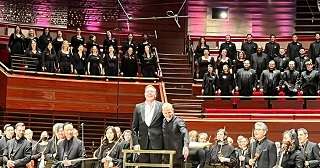
J. Miller, Y. Nézet‑Séguin (© Diana Antal)
Anton Bruckner struggled to complete his Ninth Symphony as he lay dying in bed in Vienna, Austria, in 1896. Sadly, when his life ended, he had completed only three complete movements of what was clearly intended to be a four‑movement composition. Over the succeeding decades, Bruckner scholars have tracked down and, in some cases, have almost come close to assembling enough notes and sketches to create a new edition. But fearing he would leave behind three orphaned movements without a strong finale, Bruckner supposedly offered a suggestion: just add his Te Deum as a fourth-movement substitute (some scholars insist it was the conductor Hans Richter who made this suggestion, which the ailing composer accepted without argument). No matter that the Te Deum was composed in 1884 and stylistically different from—some might even say at odds with—the three‑movement Ninth. It was one way, possibly the only way, to save the symphony from oblivion.
While scholars continue to debate whether or not the Te Deum is appropriate, the Philadelphia Orchestra under the direction of Yannick Nézet‑Séguin took the plunge recently and went one step further. In two performances, Nézet‑Séguin not only substituted the Te Deum for the incomplete fourth movement, but also introduced the massive symphony with a sweet rendition of Bruckner’s motet, Christus factus est, sung a cappella under the direction of Joe Miller. Once I recovered from the shock of hearing the motet seamlessly transition into the instrumental first movement, all was well. Both motet and finale offer glorious music sung and played by some 200 artists, revealed in its original splendor if not the exact order Bruckner would have conceived. What followed was a stirring performance and a major step forward for the orchestra’s indefatigable director.
Nézet‑Séguin has matured tremendously in the 11 years he has been music director in Philadelphia. His earlier performances of classics were crowd‑pleasers, but a little thin compared with those by some of his illustrious predecessors. Despite the enormous increase in responsibilities in recent years, as he leads the orchestras of both Philadelphia and the Metropolitan Opera, his interpretative range has deepened. He senses and reveals the intention of the musicians, the composer, and his own understanding of a work and manages to sweep these impressions into a whole that connects the hearts and minds of listeners with great art.
Joining the orchestra and the Philadelphia Symphonic Choir were four excellent soloists in the two choral portions of the performance: Elza van den Heever, soprano, able to outsoar the mighty orchestral and choral forces around her, and Michelle DeYoung, mezzo-soprano, tender in the opening motet, commanding in the thundering Te Deum; Ryan Speedo Green, expressive bass-baritone, fresh from his critical triumph in Champion at the Met with Nézet‑Séguin; and Sean Panikkar, a light tenor of exceptional sensitivity.
To those who insist that a composer’s work is inviolable, I say this: Keep the original score as your lodestar. But don’t be afraid to take the occasional risk. Bruckner’s Ninth with enhancements can be an opportunity to explore undiscovered terrain, to hear other points of view, and learn to understand why the original work retains the status it has achieved.
Linda Holt
Champion, Terence Blanchard’s new work at the Metropolitan Opera, has been getting a lot of press lately. It’s the first opera about a boxer, with bass-baritone Ryan Speedo Green in the lead as the ill-fated welterweight champion, Emile Griffith. But the themes are less about pugilism and more about universal human experiences of guilt, forgiveness, and compassion. Three dimensions of Griffith are revealed as this grand tragedy unfolds. Green’s Griffith is a young man disoriented in a new country, discovering his gay sexuality. Seasoned Met bass-baritone Eric Owens portrays Griffith in later years, riddled with dementia. Boy soprano Ethan Joseph offers a third dimension, a sensitive child abandoned by his mother to the care of Cousin Blanche, a sadistic religious fanatic (sung with tremendous depth and horrifying fury by Krysty Swann).

Ryan Speedo Green as Emile Griffith (courtesy Met Opera)
At its best, the two-act opera in jazz crackles with
vitality in simulated boxing choreography, providing an uneasy closure as the
three faces of the lead character find cohesion and integration. At its worst,
at three hours in length, it is too long, with an intro that drags on forever,
and a conclusion begging to be condensed. The music performed by orchestra and
jazz quartet, beautifully conducted by Yannick Nézet-Séguin, blends with the
voices on stage, providing originality and richness (I hope Blanchard plans to
create a concert suite from this varied and colorful score).
The pivot that Michael Christofer’s libretto swirls around
is a championship fight in 1962 when Griffith loses control and batters his
opponent, Paret, far beyond the limits of sportsmanship (in response to Paret’s
use of slurs regarding Griffith’s sexuality). Paret dies 10 days later, but it
turns out that he had received a damaging blow in the weeks prior to the
contest. While Griffith may be not have been directly responsible for Paret’s
death, he can find no peace, loses fight after fight, and retreats into a world
of self-loathing.
The principal singers in this production are simply amazing.
Green, so handsome in his role as the young Griffith, is everything a lead
singer should be. His voice is consistently powerful and eloquent, his acting
skills finely tuned, and such a well-paced boxing pas de deux with
baritone Eric Greene as Paret. As I experienced the opera, large screen in my
local movie theater, I marveled at the breathtaking voices, acting and dancing
expertise of these three baritones (Green, Owens, Greene) singing in close
proximity, not an opportunity that comes very often. As the elder Griffith,
Owens displays some of the finest acting skills in opera today, matched to a
voice that is one of the Met’s great treasures. “I kill a man and the world
forgives me. I love a man and the world would kill me,” he says with
ineluctable emotion.
The female roles are equally
impressive. Soprano Latonia Moore is spectacular as Griffith’s flamboyant
mother Emelda. The way she modulates her voice around a sentence or phrase,
flashing devious glances and demanding immediate obeisance: delicious! Mezzo-soprano
Stephanie Blythe is oddly menacing as Kathy Hagen, the proprietress of a gay
bar, with an array of lusty characters squirming and twerking around her. Camille
A. Brown’s choreography is a visual feast of carefully knitted movements that
seem to spring effortlessly from the storyline.
I felt a deep connection to this opera as the daughter of a featherweight champion boxer who fought in New Jersey and in Panama in the 1940s. Boxing has been and can still be a brutal sport, and a corrupt one. But it has provided a gateway through which many young men (and perhaps some young women), when outfitted in protective gear, can escape from poverty and anxiety into a world where skill matters and aspirations are more than idle dreams. I thought I’d dedicate this review to you, Dad, and for the memory of growing up with boxing gloves, jump ropes, and rosin in a pink-and-Barbie world.
Linda
Holt

fighterbrown.wordpress.com
Here is a link to my review appearing today in ConcertoNet, the international classical network.
https://www.concertonet.com/

Invictus by L.L. Holt (Harvard Square Editions, 2019) was named a Finalist in the international Next Generation Indie Book Awards for 2021. Also known as the Indie Book Awards, the literary awards program recognizes and honors authors and publishers of exceptional independently published books in 70 different categories.
Holt's novel builds on the long-persisting legend that the composer Ludwig van Beethoven may have been, or been treated and discriminated against as, a person of color during his lifetime (1770-1827)
The book is the sequel to The Black Spaniard by L.L. Holt (Unsolicited Press, 2016), a novel in which Beethoven breaks away, faces adversity, and takes Fate by the throat.
Award recognition is nothing new to this author. She has been mesmerized by Beethoven's music and life story since her childhood. Earlier, The Black Spaniard was short-listed for the GOETHE Book Awards for Historic post-1750s Fiction, a division of the Chanticleer International Book Awards. Invictus was also a Finalist for the Landmark Prize for Fiction when it was still in manuscript form (under the title, Intensia).
Holt's award is in an exciting new category designated for books that deal with issues experienced by Black, Indigenous, People of Color (BIPOC). She is currently contemplating writing a third and final novel about Beethoven as well as a fictional reimagining of the swashbuckling life story of the Chevalier de Saint-Georges, a prominent composer and swordsman during the French Revolution.

Invictus Beethoven age: 0-16 Order here: tinyurl.com/bdch9drp
The Black Spaniard Beethoven age: 21-33 Order here: https://tinyurl.com/5n79nact
Musician profile featured the Broad Street Review (Philadelphia) March 16, 2023, edition:

Review in Broad Street Review (Philadelphia, PA) March 2023.
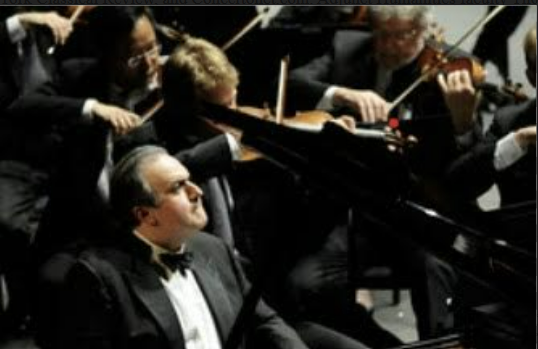
Yefim Bronfman, pianist
Excruciatingly slow and oddly pointless. Can this still be Beethoven? Review in ConcertoNet.com
https://virtualvenue.feelitlive.com/fa8bac77-5d4b-445c-bcbc-d44f094bbc50
Here is a link to this lively, laugh-filled interview program conducted weekly on the Internet by Win Derman. Alternatively, search for FeelItLive, the Win-Win Show, Episode 55 with Dr. Linda Holt . Click on the link above, not the photo below.

I was privileged to discuss contemporary classical music in China for this new documentary produced by the Central Conservatory of Beijing. You may view the entire 30-minute documentary on YouTube or Facebook (The Violin Channel). My comments are from counter 16:40 to 22:00.

12/15/20 Eve of Beethoven's 250th Birthday
This was also published in ConcertoNet.com
Igor Levit, the young German-Russian pianist, knows how to get to the heart of a matter.
In 2016, he delayed a performance to
address the audience on tolerance and human rights. This May he live-streamed
Erik Satie’s Vexations for a global audience, repeating the same four lines for
nearly 20 hours to express the frustration of artists during the pandemic. Without
fanfare, he has recorded the complete 32 Beethoven piano sonatas for release
during the composer’s 250th birthday year.
Now, on the eve of that birthday, I have
the pleasure of reviewing something much shorter, but perhaps even more to the
point: Levit’s performance of the Ode to Joy from the Ninth
Symphony, as transcribed by Franz Liszt. This transcription is less than four
minutes in length but acts as a punctuation mark for all we have suffered,
endured, and perhaps triumphed over in the memorable year of 2020.
The transcription begins
at the point where the cellos and basses softly announce the familiar theme. It
ends with some Lisztian flourishes and sinks back into the simplicity of the
opening well before the first words ever heard in a symphony: “O Freunde, nicht
diese Töne.” (“Friends, let’s not have these somber
tones.”)
Of course, there
are no cellos, basses, and baritones in this recording. There is only Igor
Levit. And Beethoven.
The theme begins
meekly, in naked simplicity. It is a handful of seeds—plain, homely, covered
with soil—sown by a farmer with a great vision. The farmer knows it will take much
work, much cultivation to bring these small unprepossessing pieces to fruition.
They look like little bits of stone, with no value. But with care and
nurturing, they take root and sprout. Fast forward to a time when all the previously
untilled land—everything we think of as dirt, mud, and filth—is covered with glistening
greenery, and the seed has turned into a cornfield, a forest, a living world.
Beethoven’s music
is nothing if not organic. Like seeds with careful tending, the tendrils of his
music spread and insinuate themselves into our souls. A man of the cloth as
well as a composer and musician, Liszt knew what he was doing when he took
Beethoven’s own development of this theme early in the Ninth pretty much as is,
then let it grow naturally into an inevitable conclusion. Liszt hands it off to
the performer, and it is up to Levit to interpret the shape and flow of this
little piece over the course of three minutes and forty seconds. This he does
with customary brilliance, turning a short-lived miniature into a harkening of eternity.
And so together,
we may say, Happy Birthday, Herr Beethoven. And thank you.
--Linda
Holt

by Linda Holt
Life is seeping back into the worldwide classical music community, and, to quote Fred Rogers, it’s a “lovely day in your neighborhood” when musicians of the caliber of Roman Rabinovich and the Scottish Chamber Orchestra are playing Mozart and Beethoven live for all to stream.
I caught the Israeli pianist and a quintet of SCO musicians
on the last night of the Lammermuir Festival’s concert series September 19 (a Janacek opera was scheduled to follow on the 20th). Like practically all
musical events in spring, summer, and autumn of 2020, the Lammermuir Festival
was rattled by the consequences of the pandemic, but emerged unbowed in September
rather than April or May, and with a schedule of performances different, but in
no way diminished, from original expectations.
Performed in the 250-year-old Holy Trinity Church in
Haddington, East Lothian, Scotland, Saturday evening’s concert featured a socially
distanced subset of the SCO playing Mozart’s plaintive String Quintet No. 5 in G
minor K. 516, followed by a real treat: a chamber rendition of Beethoven’s
Third Piano Concerto in C minor, Op. 37 arranged for string quintet and piano by Vincenz Lachner.
The acoustics of Holy Trinity are quite good, embracing the
mellow, woodsy voices of two violins (Ruth Crouch and Gordon Bragg), two violas
(Felix Tanner and Brian Schiele), and cello (Donald Gillan). The mood of their
playing was soft and reflective in a work which often lends itself to emotionalism
which some reviewers think is outside the scope of the classical tradition. Both
approaches have their merits, and while my ears were perfectly content to
resonate with the ensemble’s tender murmurings, a little more of that G minor
Angst wouldn’t have hurt, especially in the third movement. But for pure
loveliness and exquisite musical sensibility overall, you could not do better
than this interpretation.
Roman Rabinovich pumped up the volume the instant his
fingers first fell upon the keys, and oddly enough, it sounded fabulous with a
mere five musicians (the second viola swapped out for a double bass played by
Nikita Naumov) as his musical partners, as opposed to the full orchestra we
most often hear.
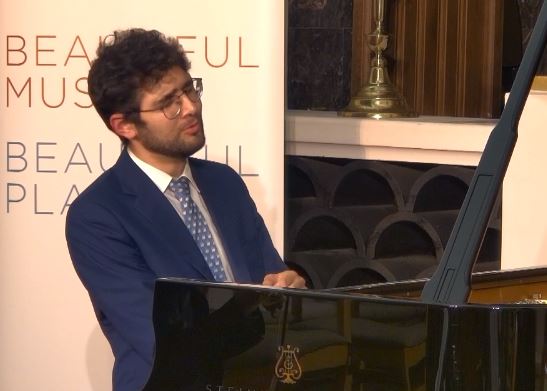
Rabinovich is an exciting musician to watch and listen to,
and I don’t mean exciting in the sense of histrionics. While his facial
expressions and gestures do reflect the moods of the music, there is nothing
artificial about this performance. His playing—at once assertive and seductive—reveals
the true, full-blooded Beethoven: the emerging Romantic, the technical wizard,
the bearer of the Promethean flame. Rabinovich knows that Beethoven wields
trills—the Milquetoast ornaments of an earlier age—as though they were light
sabers, ready to slash through hypocrisy and liberate music from all restriction.
I was amazed at just how fine the SCO instrumentalists
sounded in sync with this powerful but insightful unfolding of a familiar masterwork.
With its passionate minor mood radically shifting to C major at the end, the
concerto seems to foretell a return to life, perhaps even a resurrection. It’s
an apt term for what musicians around the world are experiencing as they return
to the stage, and not a bad metaphor to use in a church.
My review of another Lammermuir Festival concert appears in
Bachtrack here: https://bachtrack.com/review-video-purcell-dunedin-consort-lammermuir-festival-september-2020
 Re
Re